Guest Column: When in doubt, notch it out
By Col. Matt Talbot, DMR Marine Patrol
One of the questions always asked when a Marine Patrol Officer begins in a new area is “What do you consider a v-notch?”
Before addressing that question, a little history on lobster conservation going back over 150 years is in order.

Col. Matthew Talbot is the DMR Bureau of Marine Patrol Chief
The year was 1872 when the State of Maine first made it unlawful to catch, buy, or sell egg-bearing female lobsters. The next 17 years brought both a repeal of the law and then subsequent prohibitions on catch and possession during certain times of the year. In 1889, catching or possessing egg-bearing female lobsters was again prohibited throughout the State. In 1903 the legislature appropriated funds to support the purchase of egg-bearing lobsters from harvesters, who were allowed to keep them for the sole purpose of conservation and to help deter what we now refer to as “scrubbing”. '
As a note of interest, this initiative by the legislature resulted in the purchase of the first vessel owned by the Sea and Shore Fisheries commission, a naphtha-powered launch used to aid in the collection of egged lobsters from harvesters along the coast. The lobsters were either released in Maine waters or transported to the U.S. Hatchery in Gloucester, Massachusetts for the propagation of their eggs. Female and young lobsters were later returned to Maine.
Maine began marking female egg-bearing lobsters in 1917 in what later would come to be known as the Seed Lobster program. The State purchased egg-bearing lobsters and prior to their release Sea and Shore Fisheries wardens would punch a hole in the middle tail flipper to indicate a reproductive female lobster; these “punched” lobsters were also required to be liberated if re-caught.
In 1948 the State changed the punch-tail to a middle flipper v-notch. In 1957 the possession of lobsters mutilated in a manner to hide the notch became illegal. It wasn’t until 1975 that the v-notch was specified to be placed in the right flipper next to the middle flipper.

While taking and possessing punch-tail or v-notch female lobsters was illegal prior to 2003, it wasn’t until then that v-notching an egg-bearing female lobster went from voluntary on the part of the lobsterman to becoming mandatory under the law.
So, back to the question: “What do you consider a v-notch?”
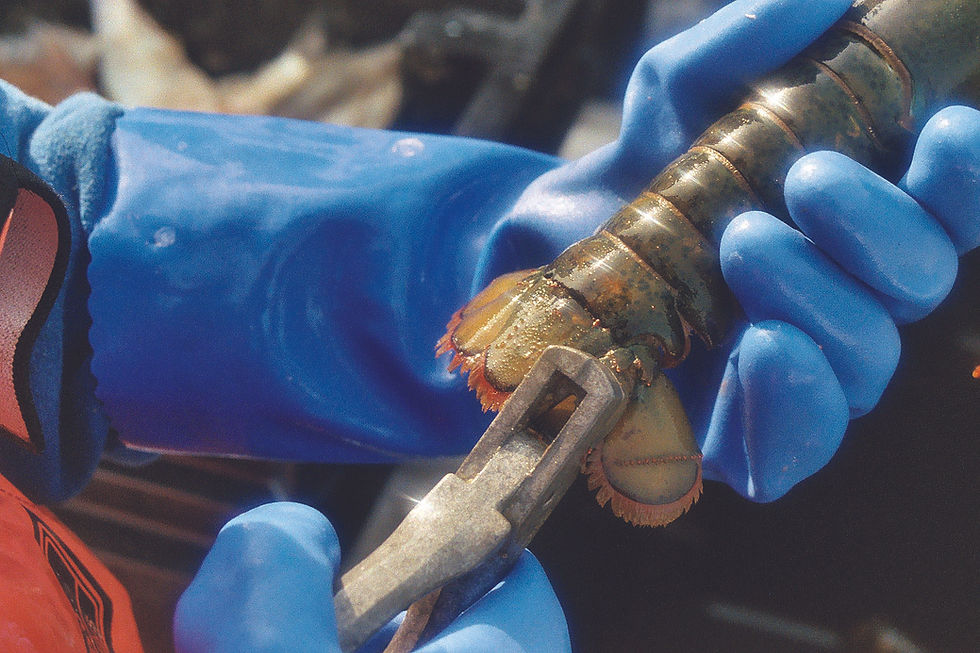
The law states a v-notch must be “…in the right flipper next to the middle flipper…as determined when the underside of the lobster is down and its tail is toward the person making the determination.” Because no specific measurement is provided under Maine law or by ASMFC for LMA1, a v-notch could be any size.
Virtually every lobsterman I’ve worked with over the years knew a v-notch lobster when they saw one and if unsure it usually got re-notched and thrown over the rail. I was often told: “If I’m not going to keep it then the next guy shouldn’t either.”
It’s been my experience that when a lobsterman asks this question what they are usually wanting to know is what the local officer is going to consider to be a mutilated tail. Once again there is no size specified by statute, no measuring tool authorized to be used. There is however a little common sense.
If a v-notch can be any size, then the mutilation that could hide or obliterate that mark could also be any size. The cause of the mutilation is irrelevant. At the end of the day, if your local officer seizes a v-notched or mutilated female lobster from your catch he or she may have to explain to a judge or jury (who may know nothing about lobsters) how they determined that tail flipper to be illegal. Point being… a little common sense and reasonableness goes a long way.
Some points of interest based on common questions that do get asked are:
Where on the flipper does the notch need to be?
The notch or mutilation should be along the bottom edge below the horn.
What if the flipper is missing?
If the flipper is missing then the lobster is mutilated; if it has started to grow back and is not notched or otherwise mutilated it is legal.
What if the notch or mutilation has hair?
Setal hairs don’t factor into this conversation on v-notched or mutilated lobsters.
While we continuously strive for enforcement consistency, we, like lobstermen, are individuals. It’s always best practice to be on the same page as your local officer. If you haven’t, talk to your officer the next time you get boarded or checked at the dock. If you find a questionable tail in your trap, take a picture before you re-notch it and have that conversation later.
Over the course of my career, I have notched and released crates upon crates of egg-bearing lobsters from the seed lobster program. I have also written fistfuls of warnings for minor v-notch and mutilated tail violations as well as numerous summonses for more serious v-notch, mutilated tail, scrubbing, and failure to v-notch or failure to immediately liberate egg-bearing female lobster violations. Over the past twenty-four months, officers have written 14 summonses and 71 warnings for possession of v-notch or mutilated female lobsters.
From an officer’s perspective the goal of enforcement is voluntary compliance. We are here to support your industry by ensuring you are comfortable doing the right thing because you know we are holding your fellow fishermen to the same standard.
Lobstermen for decades have supported v-notching as one of the most effective conservation and stewardship methods available to support a healthy fishery — an investment in their fishing futures and the fishing futures of their sons and daughters.
When in doubt — notch it out.


Comments