Maine Lobstermen's Association Update | July 2026
MLA June Board Meeting
The MLA Board met on June 3 in Port Clyde. Chairman Sonny Beal thanked Gerry Cushman for hosting the meeting. The board heard reports from the Executive Board and Emerging Issues Committee. The Executive Board provides guidance to staff between Board meetings on urgent or developing matters. The Emerging Issues Committee has made progress on its work regarding the effectiveness of enforcement penalties.

The MLA provided feedback to Maine’s Commercial Fishing Safety Council on safety concerns related to ropeless fishing. The MLA also submitted comments on several federal rulemaking proposals related to whale rules. NMFS has announced the timeline for new whale rules. The process will kick off with an in-person TRT meeting in early December. The proposed rule is scheduled to be published in the fall of 2027, with the final rule expected in November, 2028. During a recent TRT webinar NMFS reported that the right whale population increased four years in a row. Using serious injury and mortality data from 2020-2023, NMFS’s computer model shows a 70% risk reduction, and that the probability of extinction is low.
The MLA continues to strongly support Rep. Jared Golden’s proposal to pause the whale rules until 2035, and is committed to pursuing any proposal to ensure the lobster industry is not subjected to burdensome federal regulations.
The board continued to plan for the Billion Egg Challenge, setting the timeline, team structure, funding and outreach plans. The MLA welcomed members of the Maine Lobster Community Alliance to the board meeting. The two organizations discussed opportunities for further collaboration. The board then held a cookout for MLA and MLCA board members and their families. We had a great afternoon in Port Clyde, with time to reflect, recharge, and enjoy family and each other. It was a special reminder of why this work, and this community, matters so much.
MLA in the Community
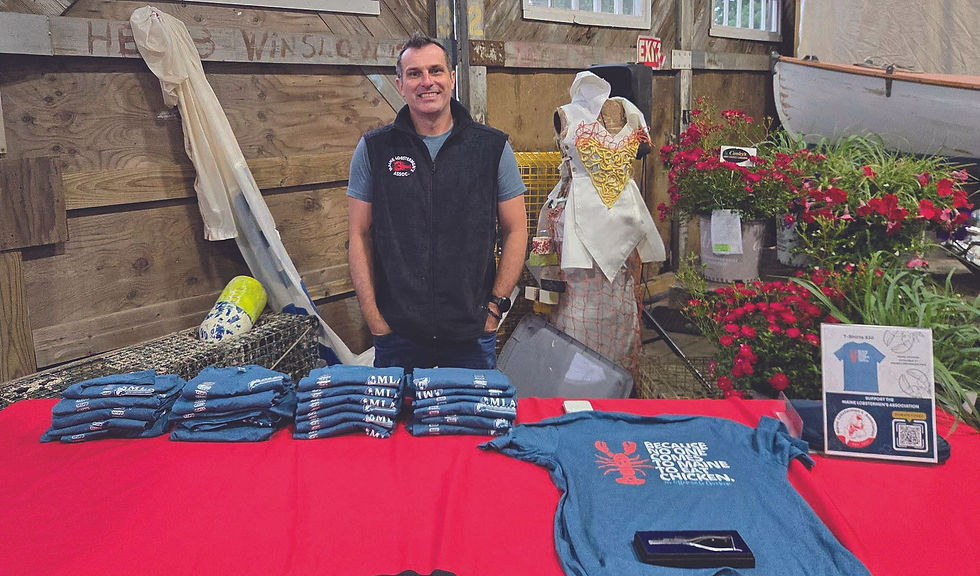
MLA’s Associate Director Chris Payne joined the Boothbay Harbor Region for the Claw Down on June 18, talking with guests about the lobster industry and selling MLA merchandise. The event draws seafood lovers to Boothbay Harbor for an night of lobster indulgence featuring talented local chefs competing with their individual lobster bite recipes. The weekend also features a Fishin’ for Fashion show and the Boothbay Harbor Lobster Boat races.
2026 Herring Season
The Area 1A herring fishery opens July 19 with a small quota allocation of 2,401 mt. Vessels will be allowed five consecutive landing days a week of up to 240,000 lbs. (6 trucks) per week. Small mesh bottom trawl vessels with an Atlantic herring Limited Access Category C or Open Access D permit may land herring six consecutive days a week.
2026 Menhaden Season
Maine’s commercial State Allocated menhaden fishery opened on June 8. It’s been a slow start to the season. Harvest days are Mondays, Wednesdays and Fridays with a weekly vessel limit of 17,850 lbs. (51 barrels) per harvester vessel. DMR will provide notice when the state allocation quota is harvested and the fishery enters the Episodic Event Set-Aside fishery (EESA) during which harvest days will Mondays and Thursdays, with a weekly vessel limit of 4,000 lbs. (40 barrels).
Industry Meetings Round Up
ASMFC’s American Lobster Management Strategy Evaluation (MSE) Steering Committee met June 8. The board created this committee at its May meeting to begin a planning process to develop goals that will guide future management of the fishery and pair new management proposals with sound economic analysis. Richard Howland, John Jordan, and John Drouin represent Maine harvesters on this committee.
The Lobster Institute hosted a Lobster Supply Chain meeting on June 11 as a forum for harvesters, dealers, processors, association representatives, and industry stakeholders from the U.S. and Canada to discuss current lobster market conditions, supply and demand trends, and related economic challenges facing the industry. The meeting focused on the current Canadian spring lobster season and what to expect for the upcoming Maine lobster season. A second meeting will be held in the fall as an update on the U.S. season.
The Commercial Fishing Safety Council held its quarterly meeting on June 17. The primary agenda item was a general discussion of fishermen’s concerns with ropeless fishing and the need to document the industry’s perspective before new whale rules are proposed. The Council is working on an industry survey to gain additional insight on safety concerns.
President Trump Restores Fishing Access in the Pacific
On June 11, President Trump signed a proclamation restoring fishing access to roughly half a million square miles of ocean in the Pacific. Earlier, in February, the Trump Administration restored commercial access to the Northeast Canyons and Seamounts Marine National Monument, located 100 miles offshore of Rhode Island. During the June press conference, President Trump restated his support for Maine’s lobster fishery and his Administration’s opposition to offshore wind.
Whale Updates
In June, the federal government had two requests for comments on whale issues. On June 2, the MLA submitted comments on possible changes to the Vessel Strike Rule. The Vessel Strike Rule requires vessels greater than 65 feet to slow down in areas where right whales have been sighted. The MLA supports flexible, practical conservation policies that protect whales while avoiding unnecessary burdens on Maine’s fishing communities.
On June 4, the MLA submitted comments on the federal List of Fisheries, making its eighth request to list the Maine state waters lobster trap fishery as a separate “fishery.” The List of Fisheries, mandated under the Marine Mammal Protection Act, categorizes U.S. commercial fisheries into three groups based on their rate of incidental mortality and serious injury to marine mammals. Surveys conducted by Maine DMR and other organizations continue to show that right whales are extremely rare off Maine’s coast.
PEI Lobster Fishery Has Multiple Whale Closures
Canadian Department of Fisheries and Oceans has implemented multiple fishing closures in the Gulf of St. Lawrence affecting the lobster fishery. Fishing grounds have been closed off P.E.I.’s North Shore, in the Gulf’s western area, and near Cape Breton. The P.E.I. Fishermen’s Association noted there have been partial closures for six weeks of the eight-week spring season with some waters permanently closed.

MLMC Board appoints new members
The Maine Lobster Marketing Collaboration (MLMC) concluded its process to fill vacant seats on the board. The 2026 MLCA board members include four Harvester Representatives: Brian Billings (Zone C), Jordan Drouin (Zone A), Matt Gillley (Zone F), serving as Vice Chair, and Abe Philbrook (Zone B). There are three Dealer Representatives: Curt Brown (Owner, Bold Coast Seafood) serving as Chair, Meaghan Dillon (VP Marketing, Luke’s Lobster), and John Petersdorf (CEO, Bean Maine Lobster). There are two Public Representatives: Cameron Dyment (Supply Chain and Distribution Manager, Cousins Maine Lobster) and Elizabeth Horton (Simmer Public Relations). There are two Commissioner’s Representatives: Jeff Nichols (Department of Marine Resources) and Abby Plante (Maine International Trade Center / Department of Economic and Community Development).
Baseline Monitoring in Research Array Starts July 13
The summer bottom trawl survey of the Maine Research Array Wind Energy Area will run for nine days, beginning the week of July 13 through August 31. The timeframe is subject to change. All surveys will be conducted during daylight hours.
The F/V Northern Lights (55’ trawler) will transit from Portland to the sampling area and will be monitoring VHF channel 16. The crew will conduct approximately 37 tows during each survey. Tows will be 20 minutes and conducted at a speed of 2.5 knots. DMR does not anticipate asking for gear to be moved for these surveys.
The point of contact for this project and for lost gear is Casey Yanos, (207) 350-7165, casey.yanos@maine.gov. If gear is lost, please contact Casey or your local Marine Patrol Officer.
Federal Lobster Vessel Tracking
The Supreme Court has not yet decided if it will hear the court case claiming that the federal lobster tracker rule is unconstitutional. Frank Thompson of Vinalhaven filed a federal lawsuit in 2023 challenging this ASMFC rule. The district court sided with the government and dismissed the case, claiming that lobstering is a “closely regulated industry” that qualifies as an “exception” to the Fourth Amendment. An appeals court upheld the dismissal in November 2025. Thompson has obtained counsel through the Pacific Legal Foundation in an attempt to take his legal challenge to the Supreme Court.
Sea Grant Requests Proposals for Collaborative lobster research
The Sea Grant American Lobster Initiative announced a funding opportunity for research conducted with and for the industry. The funding will support new collaborative research projects that closely align with emerging lobster industry and management needs. Projects must be developed and led by collaborative research teams that include at least one fishing industry representative, such as a commercial fisherman or a representative from a commercial fishing business, such as cooperatives, dealers and processors.
Launched on April 15, the USDA Office of Seafood bridges a historical gap by giving seafood producers and fishermen access to USDA programs (like grants, disaster assistance, and loans). It aims to streamline how American seafood harvesters and processors navigate federal resources and to coordinate with the U.S. Department of Commerce on the America First Seafood Strategy.
Creation of the new office signals a shift acknowledging fish as food and fishermen as food producers under USDA definitions. Fishermen have long been excluded from various USDA loan and tax programs because their harvests were not classified as agricultural products. The extensive support structure provided by the USDA to farmers and ranchers, such as marketing, loans and grants, has not been available to the fishing sector.
The U.S. House of Representatives narrowly passed the fiscal year 2027 Agriculture Appropriations Act (H.R. 8646), which includes a specific appropriation of $500,000 to fund the operations and advocacy efforts of the USDA Office of Seafood.
The Senate must now draft and pass its own version of the agricultural spending bill. For the funding to move forward smoothly, the Senate’s version must either include the same $500,000 allocation for the seafood office or accept the House’s inclusion.


Navigating a multitude of stringent regulations, from whale protection to vessel tracking, is a real mental challenge—demanding patience and precise calculations, much like solving a Dordle puzzle. Thankfully, the fishing community is persevering and has begun to find solid support from the USDA's Fisheries Office!
I enjoy physics-based driving games, and eggy car has a nice balance between challenge and casual gameplay without feeling frustrating.