Maine Lobstermen's Association Update | October 2026
MLA Board Summary
The MLA board met on September 6 following a busy summer of advocacy, outreach, and program development.
The MLA received funding from Sea Grant’s Young Fishermen’s Development Program to relaunch the lobster leadership program in partnership with the Maine Lobster Community Alliance. The two-year program will begin in early 2027, with a second program planned for early 2028. It will include leadership training covering lobster science, management, conservation, and marketing; business skills development; and a sternman training program.

The board reviewed progress on the Billion Egg Challenge as it entered its final weeks. By early September, 182 lobstermen had signed up, along with more than 1,200 public supporters from 49 states. The team competition ends September 25, with plans underway to collect the v-notches and recognize participants at the MLA Annual Meeting. The Billion Egg Challenge will continue beyond the team competition if the goal of protecting one billion lobster eggs has not yet been reached.
Right whale issues remain a major focus. NMFS has formally opened the scoping process for potential changes to federal whale rules, with comments due October 16. The MLA’s legal team is developing comments and working with the board, the Department of Marine Resources (DMR), and other industry organizations to advocate for a science-based approach that reflects improving whale trends and better Maine-specific data. The MLA is also preparing comments on NMFS’s separate Request for Information on ropeless fishing, due October 14, and continues to work on approaches to dynamic management.
Congress has also been active on the right whale issue. The House approved legislation extending the current pause on new whale regulations through 2035, although Senate action is still needed. The MLA strongly supports this legislation. The board discussed other strategies MLA is pursuing to reduce unnecessary regulatory burdens on the lobster fishery.
The MLA continues to engage with the Administration on broader seafood policy. NMFS recently released priorities for implementing the federal Seafood Executive Order, including commitments to the lobster industry 1) not to mandate ropeless gear and 2) to base future whale measures on the best available science rather than worst-case modeling, consistent with the court ruling in MLA’s legal victory. The MLA also organized an itinerary for U.S. Senate Appropriations Committee staff visiting Maine to discuss how USDA programs can be funded to support the state’s seafood industry.
On state issues, the MLA is continuing its work on legislation to strengthen penalties for serious and repeat fisheries violations. Stronger penalties were overwhelmingly supported by MLA members in the MLA’s 2025 issues survey. The MLA will present its proposal to the Lobster Advisory Council for feedback this fall. DMR is currently soliciting feedback from the zone councils on a proposal to increase the required biodegradable escape-panel size. If approved, the change would be phased in over two years and fully implemented by July 2029.
The board also discussed bait supply and menhaden management as ASMFC considers changes to the Chesapeake Bay reduction fishery and future quota allocations. The MLA will continue to advocate for increased access to menhaden quota for Maine’s small-scale independent operators and to protect access to affordable bait for Maine lobstermen.
Finally, the MLA continues to work with research partners on proposals through the Northeast Sea Grant American Lobster Initiative. Projects include research on V-notching, incorporating economic information into lobster management, conducting an annual lobstermen economic survey, and building stronger socioeconomic data capacity for the fishery.
Leadership Program to Start again in 2027!
The MLA and the Maine Lobster Community Alliance are relaunching the Maine Lobster Leadership Program in early 2027. The program will provide practical skills, financial capability, and leadership development to help young people build meaningful careers while strengthening the long-term resilience of Maine’s lobster industry and coastal communities.
The program will include leadership training to build knowledge and confidence needed to engage in industry decision making and assume future leadership roles. Participants will learn about fisheries science, management, conservation, marketing, and the regulatory process. The business component will focus on developing business and financial management skills needed for a successful owner-operated fishing businesses, including budgeting, financial planning, business management, taxes, and long-term planning. The first-of-its-kind sternman training will provide hands-on fishing skills, safety knowledge, and practical experience needed to become reliable, productive crew.
Billion Egg Challenge completed
After a summer of friendly competition, SOUTHERN MAINE FUTURE CATCH has officially won the Billion Egg Challenge and will be awarded the coveted Motha Notcha Trophy during the Maine Fishermen’s Forum!
Southern Maine Future Catch: 34,070 notches
Downeast Tail Pinchers: 29,388 notches
Midcoast Notchmen: 27,583 notches
As of September 25, Maine lobstermen reported 91,041 notches, protecting an estimated 910 million lobster eggs. That’s something worth celebrating!
We came very close to meeting our goal on National Lobster Day. But as every lobsterman knows, you can only notch the eggers that crawl into your traps. We set a big goal, and Mother Nature decides when — and where — those egg-bearing females show up. So while the team competition ends September 25, the Billion Egg Challenge does not.
Maine lobstermen will keep doing what they’ve always done: V-notching egg-bearing females to protect the future of the lobster resource. And Challenge participants will keep reporting those notches until we have protected ONE BILLION EGGS.
The MLA wants to give a huge thank you to every lobsterman who participated, reported notches, and showed the world what this fishery’s commitment to conservation looks like.
And don’t dump those jars when the competition is over. The MLA will collect them to show clearly what protecting 1 billion lobster eggs looks like.
National Lobster Day and Maine Lobster week
The Maine Lobster Marketing Collaborative (MLMC) organized Maine Lobster Week leading up to National Lobster Day on September 25, using the week to promote Maine lobster and the people behind the fishery. Restaurants, lobster shacks, food trucks, and other businesses from Kennebunkport to Bar Harbor featured Maine lobster and helped share the industry’s story with consumers.
For lobstermen, the timing of Maine Lobster Week is important. While much of the fleet is working long days, the MLMC is working to make sure the public understands the hard work, conservation ethic, and generational heritage behind Maine lobster while building demand for lobster following peak tourist season. Maine Lobster Week highlighted the owner-operated businesses and coastal communities that depend on the fishery, along with the conservation practices that have helped sustain the resource for generations.
Maine Lobster Week also featured the Lobster Roll Remix at Southern Maine Community College on September 23. Chefs from restaurants across the state put their own creative spin on the classic Maine lobster roll, giving attendees another way to experience and celebrate Maine lobster. Proceeds from the event benefited the Maine Lobster Community Alliance, helping support its work to preserve Maine’s lobstering heritage and strengthen the future of the industry and the families who depend on it.
That message matters. Maine lobster is more than a product. It reflects decades of stewardship by lobstermen committed to protecting the resource and preserving the fishery for the next generation.
Menhaden Draft Addendum
The Atlantic States Marine Fisheries Commission (ASMFC) is taking public comment on Draft Addendum II for Atlantic menhaden. The proposal focuses on the Chesapeake Bay reduction fishery, which harvests menhaden for products such as fish meal and fish oil. ASMFC is considering reducing the amount that can be harvested by that fishery in Chesapeake Bay by as much as 50%, along with options to spread its harvest more evenly throughout the fishing season. The draft also considers tying the Chesapeake Bay cap more closely to the overall coastwide menhaden quota.
Menhaden is now the primary source of bait for Maine lobstermen. Changes to how the resource is allocated can affect how much fish is available to smaller bait fisheries along the coast. MLA supports increasing Maine’s access to the menhaden quota so that more fish can be available to small-scale independent fishermen and the lobster industry. Protecting and expanding Maine’s access to menhaden and supporting lobstermen remains a top priority for MLA.
ASMFC held a virtual public hearing for Maine, New Hampshire, Massachusetts, and Rhode Island on September 29; written comments are due October 9. ASMFC is expected to consider final action on the addendum at its annual meeting in November.
Menhaden Season Wraps Up
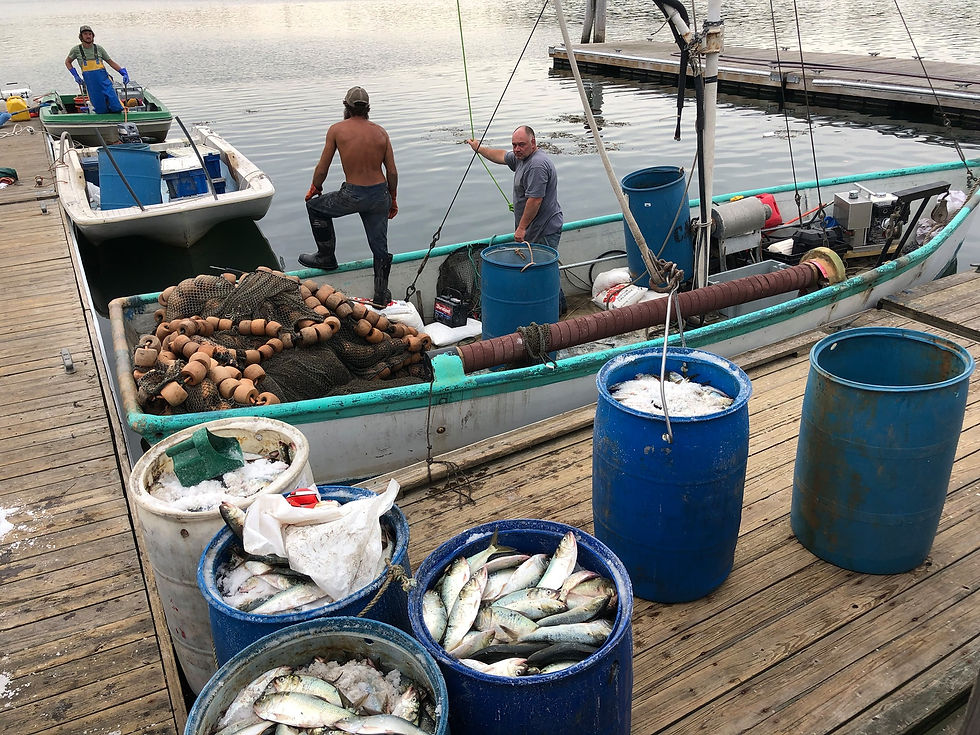
Maine began the year with a state allocation of about 19.6 million pounds —
roughly 20% less than in 2025 after ASMFC reduced the coastwide quota. The state-directed fishery opened June 8 and closed August 11 when DMR projected that Maine’s allocation had been harvested. Maine then entered the Episodic Event Set-Aside fishery, which opened August 17 and closed August 21 when the remaining shared episodic quota was estimated to have been landed by Maine and Massachusetts fishermen.
DMR then secured quota transfers from other states, allowing Maine’s directed fishery to reopen on August 31. Harvest was limited to Mondays and Thursdays with a 7,000-pound daily trip limit. Additional transfers and slower landings allowed DMR to keep the fishery open into late September.
Accurate and timely reporting has been a major issue this season. DMR suspended 37 menhaden licenses in August because required trip reports had not been filed and sent another round of warning notices for additional missing reports. DMR warned that unreported landings make it difficult to know how much quota remains and could force the fishery to close early. The Department later thanked harvesters for quickly submitting missing reports, noting that improved compliance helped extend access to the fishery.
The season shows how important Maine’s state allocation, the episodic set-aside, quota transfers, and timely reporting are to keeping local menhaden available for bait. As of September 25, there were less than one million pounds of quota remaining. DMR closed the 2026 menhaden season on October 4.
Herring Season Update
The 2026 Atlantic herring quota for all areas is 9,134 metric tons (mt) of which 16% has been landed (Area 1A at 15%, Area 1B at137%, Area 2 at 0.4%, and Area 3 at 14.7%) as of September 24.
The Area 1A herring fishery opened July 19 with a small quota allocation of 2,401 mt. As of September 24, 15% of the Area 1A quota had been landed with five consecutive landing days a week of up to 240,000 lbs. or 6 trucks per week. Small mesh bottom trawl vessels with an Atlantic herring Limited Access Category C or Open Access D permit may land herring six consecutive days a week.
NMFS does not expect to reallocate 1,000 mt from the Canadian New Brunswick weir fishery for management uncertainty to the Area 1A quota allocation this year. NMFS will make an official determination after October 1.
ASMFC estimates there are approximately 2,075 mt available for harvest during Season 2, which starts October 1. This accounts for the fixed gear set-aside, the current Area 1A catch estimate and underage from Season 1, and closing Area 1A when 92% of the quota is estimated to be landed.
ASMFC has set the Season 2 fishery to close from October 1 through October 11. The fishery will open for two landing days on October 12 and October 13. The fishery will then close again from October 14 through November 8. Beginning November 9, the fishery will move to four consecutive weekly landing days until 92% of the Area 1A quota is caught. Landing days are Mondays through Thursdays.
While the fishery is closed, harvesters are prohibited from landing more than 2,000 pounds of Atlantic herring per trip from Area 1A during Season 2, but fishing is not allowed in spawning areas during a spawning closure. The Eastern Maine Spawning closure runs August 28 through October 8, Western Maine Spawning and Mass/NH Spawning closures run September 23 through November 3.
NEFMC Lowers 2027-2031 Herring Specifications
The New England Fishery Management Council voted to set annual catch limits (ACL) for years 2027 to 2031at 6,926 metric tons, a 24% decrease from the 2026 level of 9,134 mt, and at a constant level for each year (2027-2031). The Council recognized the potential for continued negative economic impacts on the fishing industry. The decision factored in the results of the 2026 stock assessment and peer review, the Council’s Risk Policy, recommendations from the Scientific and Statistical Committee (SSC) and the Herring Committee, with input from the Advisory Panel and Plan Development Team.
Whale Updates
Maine Senators urge review of whale pause bill
Senators Susan Collins and Angus King wrote to Senators Ted Cruz and Maria Cantwell, the Chair and Ranking Member of the Senate Commerce Committee respectively, urging them to advance the Northeast Lobstermen Protection Act in their committee as soon as possible.
The bipartisan legislation, which was introduced by U.S. Representatives Jared Golden and Mike Lawler, recently passed the House of Representatives and would extend the current pause on new North Atlantic right whale regulations through 2035.
The MLA is grateful to Senators Collins and King for their longstanding leadership in defending Maine’s thousands of lobstermen and families who depend on the lobster industry. The MLA joined them in urging Senators Cruz and Cantwell to advance the Northeast Lobsterman Protection Act through the Senate Commerce Committee.
NMFS Seeks Input on Potential Future Whale Rules
NMFS is seeking ideas and suggestions regarding potential amendments to the federal whale rules. Comments from the scoping period will inform discussions during the upcoming 2026 and 2027 Atlantic Large Whale Take Reduction Team meetings and in the National Environmental Policy Act (NEPA) analysis of a 2028 ALWTRP amendment.
The scoping process is an early step to get public input on the scope of the regulations. Comments must be received by October 16 through regulations.gov.
NMFS Request for Information on Ropeless Fishing
NMFS is seeking information on the potential voluntary use of ropeless fishing gear, which includes on-demand fishing gear and other fixed gear that does not use persistent buoy lines. Responses may inform the potential future voluntary use, development, and management of ropeless fishing in the Northeast lobster/trap and other fixed gear fisheries. NMFS will summarize the responses and share that summary publicly. Responses are due on or before October 14.
COMMENT DEADLINES
Ropeless Fishing
Request for Information
Due October 14 2026
https://www.regulations.gov Enter NOAA–NMFS–2026–2080 in the Search box.
Click on the ‘‘Comment’’ icon, complete the required fields, and enter or attach your comments.
Scoping
Potential New Whale Rules
Due October 16, 2026
https://www.regulations.gov Enter NOAA–NMFS–2025–0041 in the Search box.
Click on the ‘‘Comment’’ icon, complete the required fields, and enter or attach your comments.
Menhaden
ASMFC draft Addendum II
October 9, 2026
Comments via Email: comments@asmfc.org
Subject line:
Atlantic Menhaden Draft Addendum II


Comments