Alewives Annual Return A Statewide Success Story

By Melissa Waterman
It’s the little things that matter. Take alewives, for example. These round-bellied little fish return to Maine rivers and streams each spring, packed full of oil and nutrients. Lobstermen eagerly await their arrival to use as fresh bait in the early summer. In fact, an array of hungry creatures wait for the alewives’ return, from bald eagles and eels to seals and ospreys.
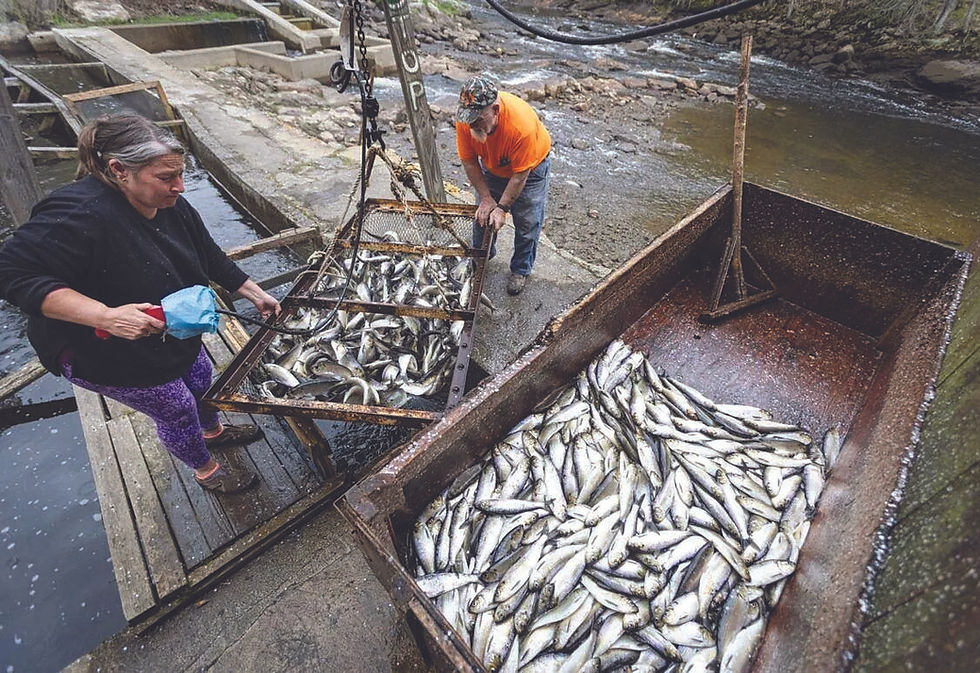
Even the alewives that die during the spring migration have value. As they decompose, they add key nutrients to the freshwater ecosystems.
Alewives have had a resurgence in Maine after many decades of decline due to polluted water, dams, and other obstructions to their annual migration. The state has the only active commercial harvest for alewives on the East Coast. Efforts by local conservation organizations, towns, and the state have resulted in the removal of river dams, fish ladder construction and restoration, stream crossing remodeling, and stocking of freshwater lakes and ponds.
These efforts have shown results. The Department of Marine Resources (DMR) records show a three-fold increase in commercial landings in the last ten years.
The Atlantic States Marine Fisheries Council, which has management authority over alewives, approved five new commercial alewife harvest sites in Maine in 2024, a reflection of multipronged actions to restore alewife passage.
One of the new sites is in Pembroke on the Pennamaquan River. Thousands of adult alewives now return to the river each spring to spawn in freshwater lakes upstream.
The alewives had been thwarted by an old dam on the river. A fishway built years ago to provide the alewives a route around the dam had deteriorated to the point that the fish weren’t able to use it. The town, with assistance from Maine Sea Grant and DMR, got to work. Once the fishway was repaired, alewives began to make their way upstream again. Fish counters recorded increasing numbers of the little fish. In 2023 nearly 500,000 were found in the river above the dam.
“Resuming the commercial harvest indicates that the run is now meeting population goals that indicate that the run is sustainable,” Michael Brown, DMR scientist, said in a 2025 interview. “This means that production of adult and juvenile fish is more plentiful now and is able to contribute significantly to the ecology of the watershed and support fish and wildlife that frequently rely on river herring for food.”
Further south in the town of Westbrook, Mill Brook Preserve provides key habitat for alewives. In late May the alewives enter the Presumpscot River from Casco Bay, then swim up Mill Brook until they reach Highland Lake, their native spawning ground. The migration distance is almost 11 miles. After spawning, the adults remain in the lake through the summer. In late summer the adults and new juvenile alewives will travel back down the rivers return to the ocean.
Hundreds of people visit Mill Brook Preserve every spring, walking to a few pools where the alewives gather before their next push upstream.
Adult alewives may make three to four migration trips in their lifetime. In fact, biologists at DMR this winter collected scales from a 10-year-old alewife on the Dennys River, which ties the record for the oldest alewife sampled by the department.
They may be little, but due to the efforts by so many in Maine, the state’s alewives are once again thriving.


Comments