Your Questions, Answered: Is the Gulf of Maine getting colder?

By Melissa Waterman
The Gulf of Maine has been recognized as one of the fastest-warming ocean regions on the planet, warming at a rate of 0.84°F per decade, nearly triple the global ocean average. Temperatures in the Gulf have consistently been 92% above average since 2010.
Lobstermen and scientists, however, have noticed that during the past two years Gulf of Maine temperatures have been much cooler. What’s happening? Are the headlines wrong?
It depends on how deep in the water you look. At the surface, the Gulf has remained quite warm. In deeper water, such as in the Gulf’s many basins, water temperatures have been much colder than in recent years.
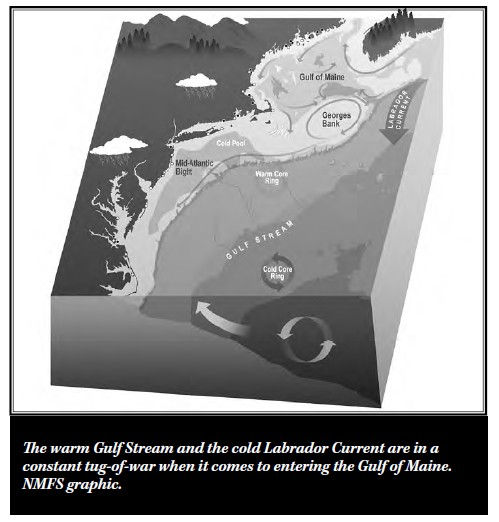
Deep water temperatures in the Gulf are controlled by two competing forces — the Gulf Stream and the Labrador Current. The Gulf Stream sweeps warm, salty water from the south very close to Gulf of Maine; the Labrador Current brings cold, oxygen-rich water from the north along the Nova Scotia coast to the Gulf’s Northeast Channel. Which current is stronger largely determines the temperature of the water that moves into the Gulf.

Think of it as a long-term arm-wrestling match. Sometimes one current is winning, sometimes the other. Deep water temperature data show that, beginning in 2024, the Labrador Current started winning again.
The National Marine Fisheries Service (NMFS) State of the Ecosystem report for New England reported that oceanographic and ecological conditions in the region were quite different in 2024 compared to previous years. Data showed inputs of colder and fresher northern water into the Gulf of Maine and the delayed migration of many marine species in the region.
Cold, dense water fueled by increased Arctic ice melt was carried by the Labrador Current south along the Scotian Shelf and into the Gulf of Maine through the Northeast Channel. The Gulf Stream shifted away from the Gulf slightly, bringing fewer warm water eddies into the Gulf and reducing overall warming.
It takes about a year and a half for cold water entering through the Northeast Channel to circulate counterclockwise through the Gulf of Maine and its basins. In its Gulf of Maine Temperature Report for 2025, released in March, the Gulf of Maine Research Institute (GMRI) noted that the Gulf’s bottom temperature ranked as the 11th coolest year on record (-0.38°F below normal). The cooler deep water contrasted sharply with the particularly warm surface water that year.
“The year 2025 marks the second occurrence since 2010 of simultaneous above-average surface warming and below-average bottom cooling,” the GMRI report stated.
It’s not likely that the Gulf’s surface temperatures will cool because those temperatures are largely linked to the hotter air temperature and the stratification of water layers that occur each summer.
Scientists consider cooler deep water to be more of a pause in the Gulf’s warming trend rather than a reversal. The forecast for the next decade is not for dramatic cooling, but rather cooler-than-normal conditions compared to recent years.
What effect this pause will have on the Gulf’s lobster or groundfish stocks remains to be determined.
This article was made possible with the support of Farm Credit East Ag Enhacement grant


Comments