US-Canada Lobster Town Meeting Focuses on Management, Trade and Lobster Tagging
By Chris Brehme, Lobster Institute
More than 200 people took part in the 2026 US-Canada Lobster Town Meeting in Moncton, New Brunswick, in January. Attendees included representatives from more than a dozen lobster fishing associations, along with more than thirty seafood and marine industry companies, and many non-governmental organizations, government agencies, and universities. Hosted by the University of Maine’s Lobster Institute, the meeting brought fishermen from as far away as Cape Cod and Newfoundland.

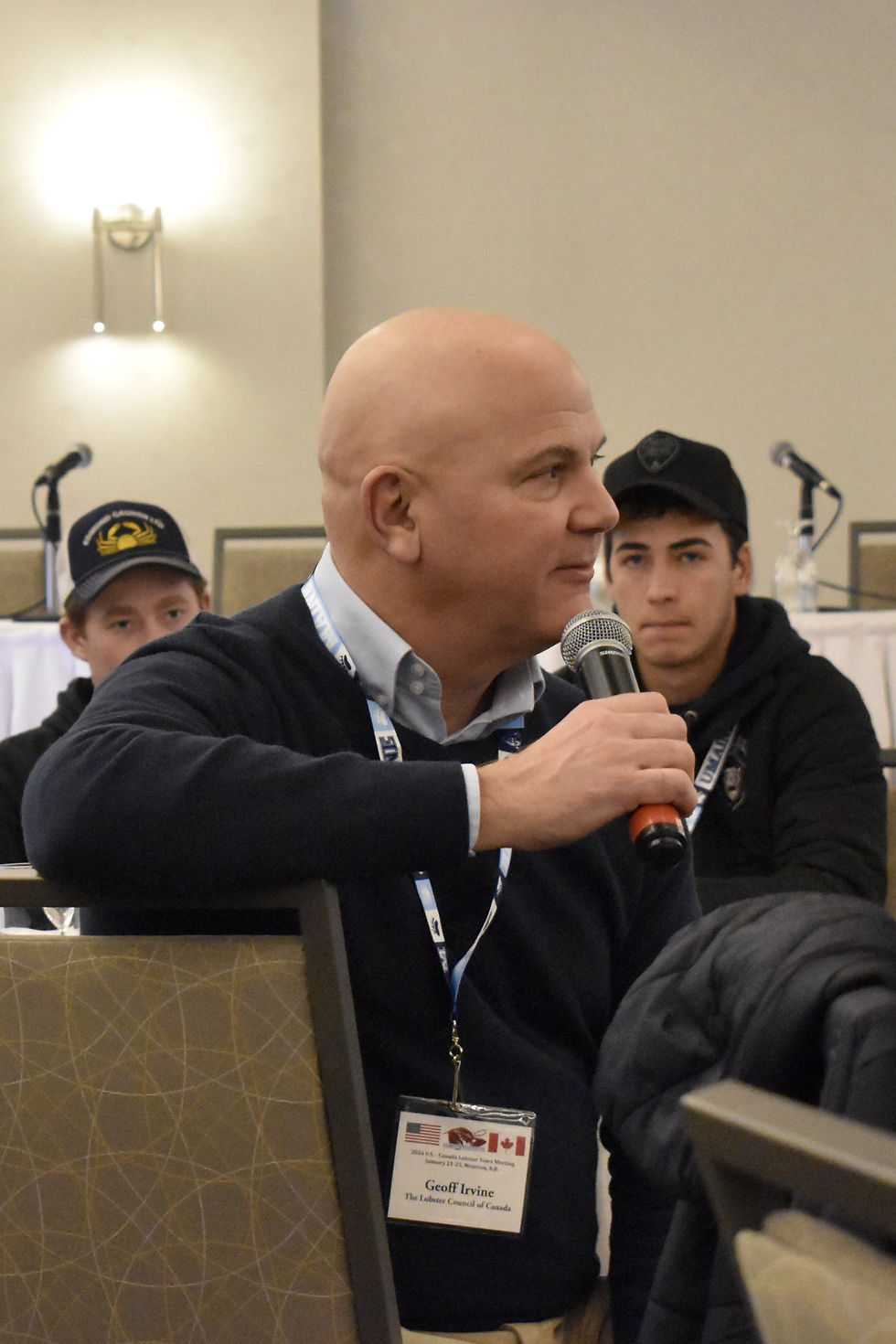
Dan Fleck, executive director of the Brazil Rock 33/34 Lobster Association, speaks to a lobsterman at the Town Meeting.
As in past years, the session themes of the Town Meeting were designed to reflect the current interests of industry. Topics included trade and tariffs, management policies, and tagging studies that have shed light on potential connections between lobster stocks.
The first morning began with brief updates from leaders representing various industry sectors in the U.S. and Canada. The updates and subsequent discussion touched upon the negative impacts of rising costs and economic uncertainty currently plaguing the industry. Organization leaders expressed concern about bait and the ex-vessel price of lobster, which remains low relative to consumer prices. Nearly all representatives agreed that communication and cooperation among industry members is more important than ever to ensure the industry remains viable.
The second session was a ‘Comparison of U.S. and Canada Management Measures’ and featured Maine Department of Marine Resources (DMR) Commissioner Carl Wilson, Massachusetts Department of Marine Fisheries (DMF) Director Dan McKiernan, Toni Kerns of Atlantic States Marine Fisheries Commission (ASMFC), Mathieu Vienneau and Kelsey Hayden of Canadian Department of Fisheries and Ocean (DFO).
Kerns began with an overview of ASMFC’s role in managing lobster through a member states extending from Virginia (where lobster is managed primarily as by-catch) to Maine. Wilson described DMR’s renewed efforts to invest in Lobster Zone Councils as a proactive decision-making structure. McKiernan expressed hope that proactive measures could help avoid future challenges, such as those posed by the 2024 minimum gauge change, which was eventually withdrawn by ASMFC. Vienneau and Hayden outlined the regulatory measures in place throughout eastern Canada, and described how these are established through Integrated Fisheries Management Plans in each of Canada’s four eastern DFO regions (Gulf, Maritimes, Quebec, and Newfoundland).
The day closed with a panel of fishing organization leaders and scientists sharing the results of various tagging studies in the Gulf of Maine, Bay of Fundy, and Gulf of St. Lawrence. These studies use a variety of tagging techniques, primarily those that require fishermen to document the tagged lobster’s location and measurements typically by taking a photo of the tag and GPS display before the lobster is kept or thrown back. Tagging studies in Canada are challenged by relatively short fishing seasons, however some technology, such as pop-up tags, makes it possible to track lobsters with high accuracy.
Day two of Town Meeting focused entirely on ‘Trade, Tariffs, and Traceability.’ Panelists discussed rising costs driven by inflation and regulatory changes, including the impending renegotiation of the US-Mexico-Canada Agreement (USMCA) and new European Union rules requiring electronic catch certificates and vessel-level documentation. These changes have the potential to add more costs and administrative burdens across the supply chain.
Market conditions are also shifting, with landings declining in parts of the U.S. and Canada while increases are occurring in some parts of the Maritime provinces. Consumer demand is moving away from live exports toward value-added products. The two countries remain mutually reliant as major markets for each other’s products, even as global competition intensifies. Concerns were raised about processing capacity, weak coordination among supply-chain actors, and ongoing tensions over pricing and profit distribution. Participants agreed that current market returns are not sustaining the entire industry and recommended forming a bilateral working group to develop clearer strategies for traceability and domestic market analysis.
The 2026 US-Canada Lobster Town Meeting closed with a shared recognition that the lobster industry is facing a period of rapid change, shaped by shifting markets, evolving regulations, and environmental uncertainty. The meeting underscored the value of open dialogue and cross-border cooperation, and reinforced understanding that the future strength of the lobster sector will depend on continued partnership between harvesters, processors, managers, and scientists on both sides of the border.


Comments